What if the quest to save your home from biting Pennine drafts accidentally leads to a costly enforcement notice from the National Park Authority? It's a valid fear for homeowners in Grassington and Reeth, where the architectural integrity of our 47 Conservation Areas is strictly guarded. You likely want the thermal performance of modern glazing but dread the thought of shiny uPVC mitre joints ruining the character of your stone cottage. We understand that for local residents, a window isn't just a fixture; it's a piece of heritage that must withstand the elements without demanding constant repainting.
Our guide to Authentic Timber-Look Flush Casements: Meeting Heritage Standards in Grassington & Reeth promises to show you how to bridge the gap between 1826 aesthetics and 2026 performance. You'll discover how to navigate the new Design Guide adopted on 18 March 2026 whilst achieving a finish that even the most eagle-eyed planning officer would struggle to distinguish from real wood. We'll examine the technical shift toward mechanical joints and slim frames that satisfy the Yorkshire Dales National Park Authority's latest requirements. By the end, you'll know exactly how to secure a draft-free, zero-maintenance home that stays true to our region's unique architectural soul.
Key Takeaways
- Learn how to balance the architectural demands of Upper Wharfedale and Swaledale with high-performance glazing that withstands the harsh Yorkshire climate.
- Understand why mechanical butt-joints are the essential secret to achieving an authentic timber appearance that satisfies strict conservation requirements.
- Discover the specific design features of Authentic Timber-Look Flush Casements: Meeting Heritage Standards in Grassington & Reeth, focusing on how they replicate traditional 19th-century joinery.
- Gain a clear roadmap for navigating the 2026 Yorkshire Dales Design Guide and the planning permission process for conservation area properties.
- Identify how to address the structural complexities of fitting modern casements into the uneven stone apertures typical of historic Dales cottages.
The Heritage Dilemma: Preserving Character in Grassington and Reeth
The gritstone cottages of Grassington and the limestone dwellings of Reeth form the backbone of the Yorkshire Dales vernacular. These homes are built to last centuries, but their windows often tell a different story. Whilst original timber frames are historically accurate, they face an uphill battle against the relentless Swaledale wind and Wharfedale rain. Over time, wood becomes porous, leading to rot, warping, and significant heat loss. This degradation forces homeowners into a cycle of expensive maintenance that rarely provides a permanent fix for drafts.
For local residents, the challenge is balancing a duty of care to the landscape with the need for a warm, efficient home. Authentic Timber-Look Flush Casements: Meeting Heritage Standards in Grassington & Reeth represent a technical breakthrough in 2026. They provide the aesthetic of 19th-century joinery without the exhausting maintenance cycle of traditional timber. By choosing modern materials that replicate the grain and profile of wood, you can protect your property's structural integrity whilst honouring its historic soul.
Why Grassington and Reeth Require Special Consideration
Both villages sit within designated Conservation Areas where external alterations are strictly monitored. Whether you own a modest terrace or a prominent listed building, the visual impact of your windows is paramount. Poorly chosen replacements, such as those with chunky frames or shiny mitre joints, don't just look out of place; they can actively devalue your property. Maintaining slim sightlines is essential for preserving the delicate proportions of Dales stone apertures. Authentic Timber-Look Flush Casements: Meeting Heritage Standards in Grassington & Reeth ensure that your home retains its architectural value whilst benefiting from modern security and insulation.
The 2026 Shift: Why Planners are Reconsidering Modern Materials
The Yorkshire Dales Design Guide, adopted on 18 March 2026, marks a pivotal shift in local planning philosophy. Planners now recognise that achieving modern decarbonisation targets requires materials that offer exceptional U-values. You don't have to choose between a cold house and a heritage-compliant one. Our uPVC windows are engineered specifically for this purpose, using mechanical butt-joints that mirror traditional joinery. This is a far cry from the shiny, mitred corners of the past. Before you submit a planning application, gather physical samples and technical specifications to demonstrate how these modern casements will enhance the character of the National Park.
The Anatomy of Authenticity: What Makes a Timber-Look Flush Casement?
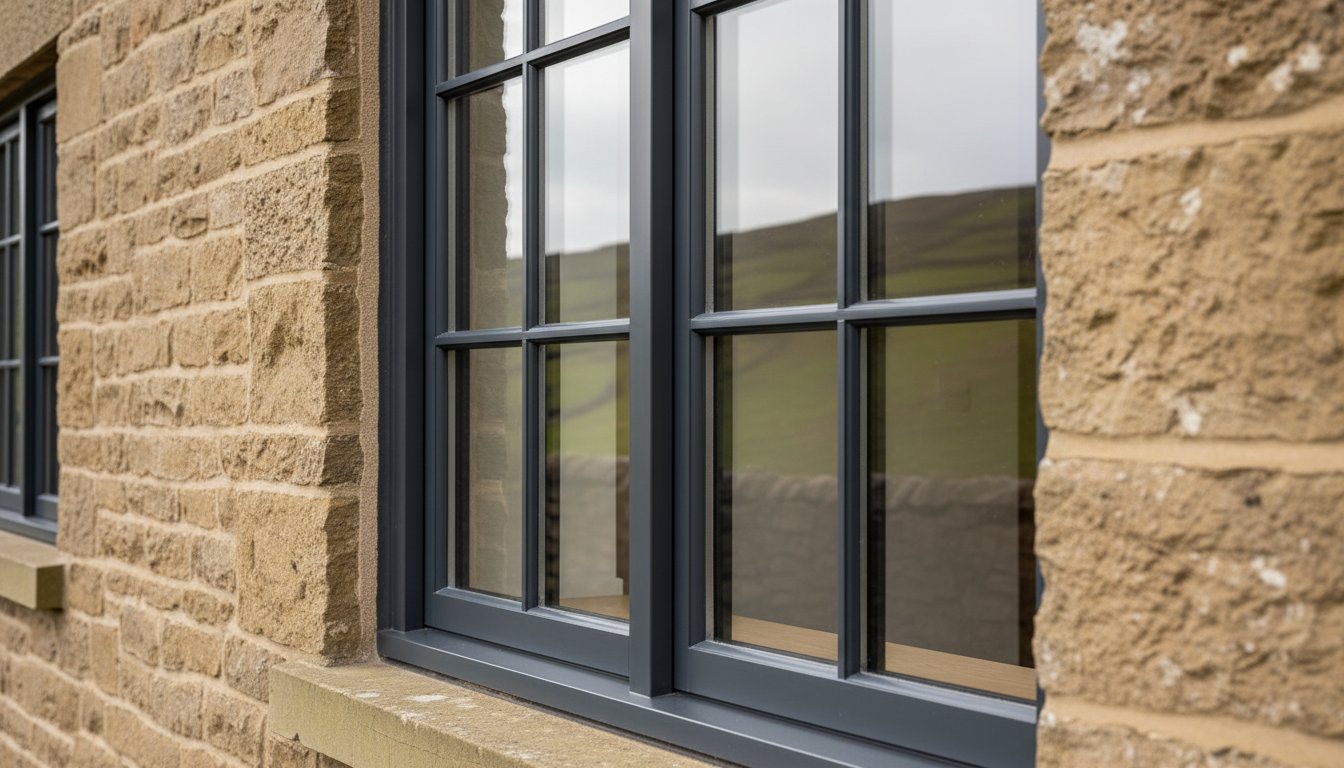
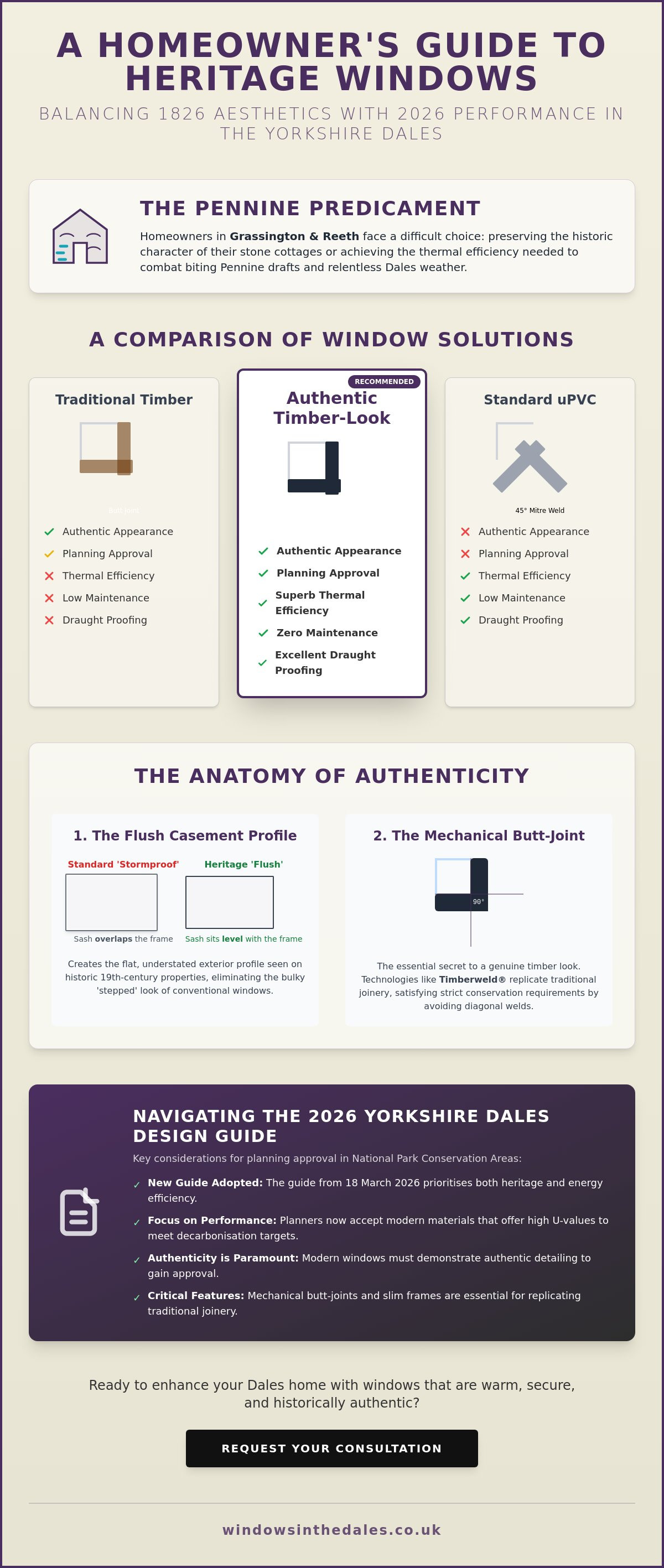
A flush casement is defined by its silhouette. Unlike standard modern windows where the sash overlaps the frame, a flush casement sits perfectly level when closed. This creates the flat, understated exterior profile seen on historic properties throughout Upper Wharfedale. Achieving this look is the first step toward Authentic Timber-Look Flush Casements: Meeting Heritage Standards in Grassington & Reeth, as it eliminates the bulky "stepped" appearance of conventional uPVC.
The real secret to authenticity lies in how the corners are joined. Most plastic windows use a 45-degree diagonal mitre joint which screams modern mass-production. Traditional timber windows were always constructed with horizontal and vertical butt-joints. Mechanical joints replicate this traditional joinery method, ensuring that the window looks like it was crafted by a local carpenter rather than a factory machine. It's a small detail that makes a massive difference to a building's character.
The Role of Timberweld® Technology
Planners in the Dales are increasingly savvy about window construction. They look specifically for the absence of diagonal welds. Timberweld is a patented process that seals the sash corners while maintaining a vertical join line. This technology provides the weather-tightness of a modern weld with the visual integrity of a mortise and tenon joint. It's the primary reason our advanced uPVC windows are frequently accepted in sensitive conservation areas.
Texture and tactile feedback complete the transformation. Authentic foils now replicate the subtle grain of painted wood, avoiding the shiny, reflective surface of older uPVC. When specifying Authentic Timber-Look Flush Casements: Meeting Heritage Standards in Grassington & Reeth, pairing the frame with period-correct hardware ensures the window feels right every time you open it. Consider these essential finishing touches:
- Monkey-tail handles: A classic wrought-iron style that adds immediate period charm.
- Traditional peg stays: These allow for manual ventilation whilst maintaining a historic aesthetic.
- Dummy stays: For those who want the look of a peg stay with the convenience of modern friction hinges.
Authentic Colour Palettes for the Dales
Colour choice is vital for blending into the local landscape. The bright, high-gloss white typical of 1990s installations is often rejected by planners because it creates too much contrast against Dales stone. Instead, choose matt finishes that complement the gritstone of Grassington or the limestone of Reeth. Heritage Greys, Cream, and Chartwell Green are popular choices that soften the building's appearance. These grained finishes absorb light rather than reflecting it, which helps the window sit naturally within its historic surroundings.
Navigating the Yorkshire Dales Design Guide: uPVC vs. Traditional Timber
The Yorkshire Dales Design Guide, updated in March 2026, serves as the definitive benchmark for any property owner in Grassington or Reeth. It moves away from a purely material-based refusal toward a design-led approach. The "Proportion Rule" is central to this. Planners now focus on the grid pattern and glazing bar layout rather than just the frame substance. If the proportions mirror the original 19th-century windows, modern materials are far more likely to be approved than they were a decade ago.
Thermal performance is another critical factor in the 2026 guidelines. Whilst traditional timber frames often struggle to meet modern efficiency standards, Authentic Timber-Look Flush Casements: Meeting Heritage Standards in Grassington & Reeth comfortably achieve U-values of 1.2 W/m²K or lower. This level of insulation is vital for Dales homes exposed to extreme weather. It ensures your living space remains comfortable throughout the winter months whilst significantly reducing energy consumption. You get the warmth of a modern build without the "plastic" look that planners despise.
The Comparison: Performance, Cost, and Longevity
Choosing between timber and modern alternatives often comes down to the long-term investment. Traditional timber requires a full maintenance cycle every four years to prevent rot, swelling, and peeling. In contrast, our high-performance flush casements offer a lifespan of 25 years or more with nothing but a simple wipe down. Beyond maintenance, security is a major advantage. Modern frames feature multi-point locking systems that provide far greater protection than old-fashioned timber latches. You can explore our uPVC heritage range to see how we combine these security features with a classic aesthetic.
Glazing Bars and Sightlines
Glazing bars are the most scrutinised element of any window replacement in a conservation area. In Reeth particularly, planners usually insist on external, raised astragal bars. These are physically fixed to the outside of the glass to create the shadow lines typical of individual panes. Cheap internal Georgian bars, which sit between the glass, are almost always rejected because they look flat and artificial. Maintaining a slim profile is equally important. Narrower frames allow for a larger glass area, which maximises natural light and preserves the elegant sightlines of historic Swaledale architecture. Using Authentic Timber-Look Flush Casements: Meeting Heritage Standards in Grassington & Reeth ensures your property meets these exacting visual requirements without sacrificing modern comfort.
Planning Permission and Article 4 Directions: A Local Roadmap
Living in the heart of the Yorkshire Dales brings a responsibility to protect our shared history. In villages like Grassington and Reeth, this responsibility is often codified through Article 4 Directions. These legal tools remove your "Permitted Development" rights, meaning you cannot change your windows without formal planning consent from the Yorkshire Dales National Park Authority (YDNPA). It's a common pitfall to assume a "like-for-like" replacement is exempt; however, changing from timber to a modern material is technically a material change that requires scrutiny from the planning office.
Success depends on your ability to prove that the new installation won't harm the local character. This is where Authentic Timber-Look Flush Casements: Meeting Heritage Standards in Grassington & Reeth become an invaluable asset. Because these windows replicate the exact proportions and mechanical joints of 19th-century originals, they are designed to align with the stringent criteria set out in the National Park's Design Guide adopted on 18 March 2026. Preparing a robust Heritage Statement is the next step. This document must detail the architectural significance of your current frames and explain how the proposed flush casements will maintain or enhance that aesthetic.
Working with the Yorkshire Dales National Park Authority (YDNPA)
We strongly recommend seeking pre-application advice before committing to an order. For a fee of £35, the YDNPA provides written guidance on whether your proposal is considered permitted development or likely to be accepted. For homeowners in Grassington, this early consultation can prevent costly enforcement notices or fines later. We support this process by providing detailed technical drawings and cross-sections that illustrate the slim sightlines and traditional butt-joints planners expect to see. You can see our heritage case studies to view successful approvals in Reeth where we've navigated these local regulations effectively.
Listed Buildings vs. Conservation Areas
It's vital to distinguish between a property in a conservation area and a listed building. If your home is Grade II* or above, the hard truth is that planners will almost certainly insist on traditional timber. However, for the hundreds of non-listed period homes within the Dales, high-performance flush casements offer the perfect compromise. They provide the visual authenticity required by the 47 Conservation Areas whilst delivering the 2026 thermal standards your family deserves. If you're unsure about your property's status, request a quote and expert guidance to find a heritage-compliant solution for your home.
Bespoke Installation: Elevating Your Dales Property with Windows in the Dales
The 'Windows in the Dales' approach prioritises local craftsmanship over factory convenience. We understand that a window is only as high-performing as its installation, especially when dealing with the historic fabric of our region. Our team combines deep geographic expertise with premium glazing to ensure every project respects the building's unique history. This level of care is vital when fitting Authentic Timber-Look Flush Casements: Meeting Heritage Standards in Grassington & Reeth. We don't just fit a window; we integrate it into the stone soul of your home.
Structural challenges are a reality for almost every older Dales property. Historic stone apertures are rarely perfectly square or level. Fitting a modern, high-performance flush casement into an uneven 19th-century opening requires precision and patience. Our installers are specialists in managing these irregularities, ensuring a weather-tight seal that doesn't rely on unsightly thick beads of silicone. We use traditional pointing techniques to match the existing mortar of your cottage, preserving the external aesthetic from every angle and satisfying the most detail-oriented planning inspectors.
The finishing touches define the final quality of the project. We offer internal window board matching to ensure the interior of your home feels as authentic as the exterior. This holistic approach is why professional installation serves as the final seal of quality for heritage standards. It's the difference between a window that looks like a modern replacement and one that looks like it has always belonged to the landscape.
Tailored to the Yorkshire Climate
Swaledale and Wharfedale properties face some of the harshest weather in England. We ensure our products are weather-tested for high-altitude conditions, so they remain draft-free during the toughest Pennine winters. Acoustic insulation is equally important, especially for homes near the bustling centres of Grassington square or Reeth green. Our flush casements significantly reduce the noise from tourist traffic and biting winds, creating a sanctuary of quiet and warmth within your home. Our commitment to high-quality workmanship ensures these benefits last for decades in every Yorkshire village we serve.
Start Your Heritage Project Today
Our consultative process begins with a detailed site survey and ends only when you're completely satisfied with the final sign-off. We focus on architecturally sensitive projects across Yorkshire, providing a bespoke service that protects your property's long-term value. By choosing a specialist who understands local stone and local standards, you avoid the financial risks of poor-quality installations. If you're ready to transform your home with a solution that balances history and performance, request a bespoke quote for your Dales home today.
Secure the Future of Your Dales Heritage Home
Achieving a perfect balance between 19th-century character and 2026 energy efficiency no longer requires a compromise on quality. By focusing on the technical nuances of the latest Yorkshire Dales Design Guide, you can protect your property's value whilst creating a draft-free living space. Success in our conservation areas depends on those critical details: the slim sightlines, the authentic mechanical joints, and the matt finishes that settle naturally into our local stone. Choosing Authentic Timber-Look Flush Casements: Meeting Heritage Standards in Grassington & Reeth ensures your home remains a warm, secure, and legally compliant part of the National Park landscape.
As specialists in Yorkshire Dales National Park planning requirements, we bridge the gap between regulatory hurdles and high-performance living. We provide expert installation into historic stone properties, delivering 2026-ready thermal performance with 19th-century aesthetics. Don't let your investment be undermined by poor-quality imitations or planning errors. Request a Heritage Glazing Consultation for Your Dales Home and take the first step toward a beautiful, zero-maintenance future. Your home deserves a legacy that lasts as long as the landscape itself.
Frequently Asked Questions
Will uPVC flush casements be accepted in a Grassington conservation area?
Yes, provided they authentically replicate traditional features like slim frames and flush casements. The Yorkshire Dales Design Guide, adopted on 18 March 2026, notes that high-quality modern uPVC can be acceptable in conservation areas if it makes a positive contribution to the heritage landscape. Success depends on matching the 19th-century aesthetic of Grassington homes exactly through correct proportions and mechanical joinery.
What is the difference between a standard uPVC window and a flush casement?
A flush casement sits perfectly level with the frame when closed, creating a flat external profile. Standard uPVC windows feature an overlapping sash that protrudes from the frame, often called a "stepped" look. This flush finish is essential for mimicking the traditional joinery found in Swaledale and Wharfedale cottages, where windows were historically designed to sit within the frame rather than over it.
Do I need planning permission to change my windows in the Yorkshire Dales?
You will likely need planning permission because Grassington and Reeth are located within designated Conservation Areas. The Yorkshire Dales National Park Authority usually requires a formal application for alterations that change the external appearance of a building. It's best to consult their planning team or pay the £35 fee for a written permitted development inquiry to avoid potential enforcement notices later.
Can you match the specific 'heritage' colour of my existing timber windows?
We offer a wide range of matt heritage foils designed to match traditional paint colours and local stone textures. Whether you need to replicate a specific cream for a Grassington terrace or a muted grey for a Swaledale farmhouse, our woodgrain textures avoid the shiny finish of standard uPVC. These finishes are designed to absorb light and blend seamlessly into the historic Dales landscape.
Are flush casement windows as secure as modern aluminium windows?
Yes, our flush casements feature advanced multi-point locking systems that provide the same level of security as modern aluminium windows. They are engineered to meet PAS24 standards, ensuring your home is protected against intruders. You don't have to sacrifice safety to achieve the historic look of Authentic Timber-Look Flush Casements: Meeting Heritage Standards in Grassington & Reeth.
How do I find out if my Reeth property is subject to an Article 4 Direction?
You should contact the Yorkshire Dales National Park Authority directly to confirm if an Article 4 Direction applies to your specific address in Reeth. These directions remove permitted development rights, meaning even minor changes require planning consent. While general conservation rules apply to the whole village, an Article 4 Direction adds further restrictions to protect specific architectural details like glazing bars and materials.
How much more energy-efficient are modern timber-look windows compared to old timber?
Modern timber-look windows can achieve U-values of 1.2 W/m²K or lower, representing a vast improvement over original single-glazed timber frames. Old wood frames often suffer from thermal bridging and significant air leakage through warped sashes. Upgrading to Authentic Timber-Look Flush Casements: Meeting Heritage Standards in Grassington & Reeth significantly reduces heat loss and eliminates the drafts typical of high-altitude Swaledale winters.
What is a 'mechanical joint' and why does it look more authentic than a weld?
A mechanical joint is a traditional butt-joint where the vertical and horizontal pieces of the frame meet at right angles. Standard uPVC windows use a 45-degree diagonal weld which creates a plastic-looking mitre. Mechanical joints replicate the mortise and tenon construction used by 19th-century carpenters. This specific construction detail is one of the primary features Dales planners look for when assessing window replacements.